


Challenges and opportunities for different players: The electric car today
Insights from Conecta’s 2025 research studies The electric vehicle market is entering a new stage — one defined not only by technological progress but by human transformation. As electric mobility becomes mainstream, the challenge for brands, insurers, and mobility providers is to connect innovation with emotion. Consumers no longer seek only efficiency or sustainability; they expect simplicity, trust, and a sense of well-being in every aspect of the driving experience.
The challenge of electric vehicles is not technical – it is emotional
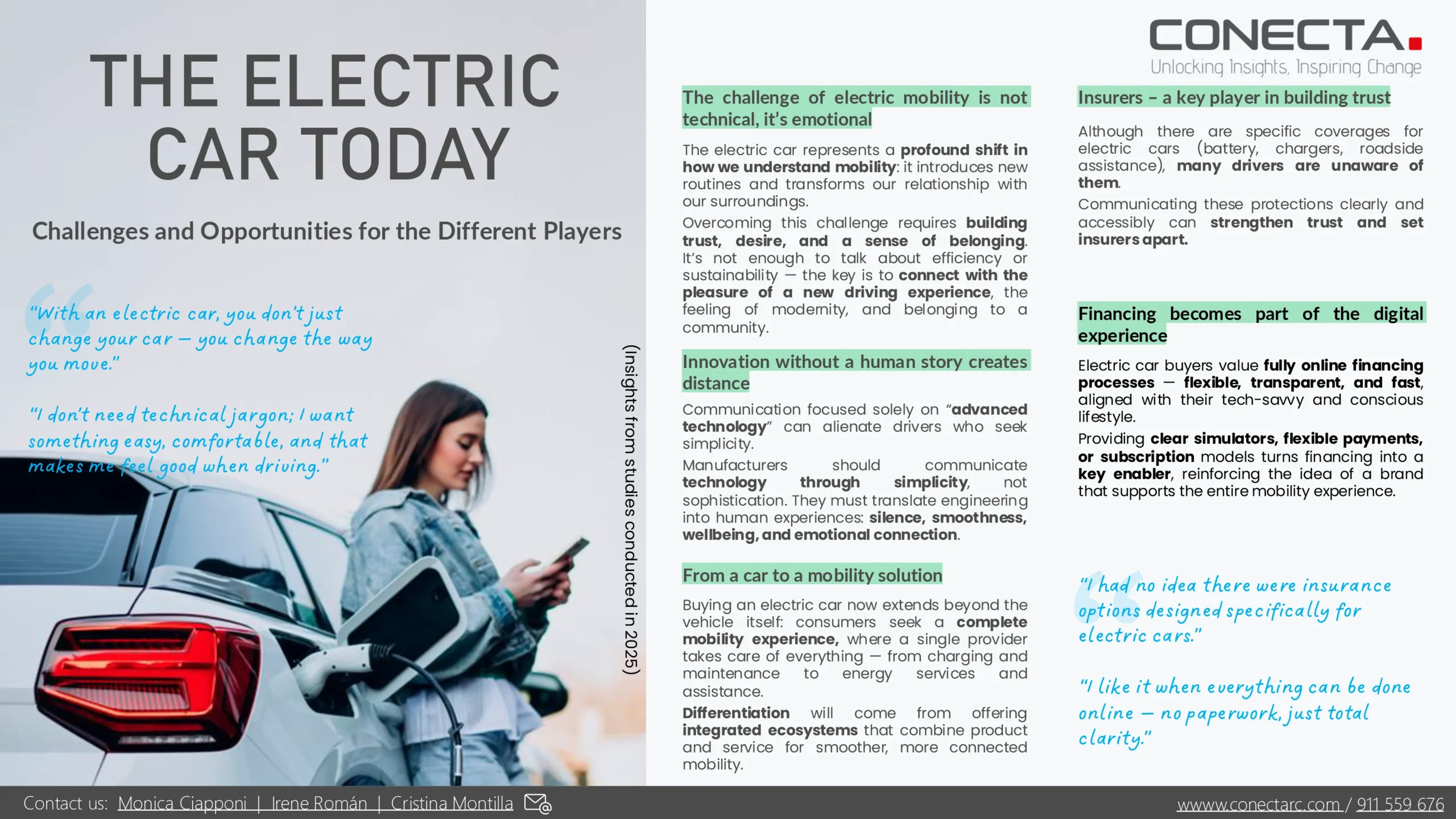
The electric car today represents a profound shift in how we understand mobility: it introduces new routines and transforms our relationship with the environment. Overcoming this challenge requires building trust, desire, and a sense of belonging. It is not enough to talk about efficiency or sustainability; it is essential to connect with the pleasure of a new way of driving, modernity, and a sense of community.
Innovation without a human narrative creates distance
Communication focused on “advanced technology” can alienate drivers who seek simplicity. Manufacturers must communicate technology through simplicity, not sophistication, translating engineering into benefits for the driver: silence, smoothness, well-being, and emotional connection.
The electric vehicle is redefining aspiration: from status to well-being
With electric cars, the vehicle stops being a symbol of status and becomes a reflection of personal well-being. It is no longer strongly associated with success or prestige but with calm, safety, and respect. Brands must connect electric mobility with values such as mindfulness, comfort, and serenity, offering an experience that inspires calm and care for oneself, others, and the environment.
From a car to a mobility solution
Buying an electric car extends beyond the vehicle itself: consumers seek an integrated mobility experience, where a provider handles everything—charging, maintenance, energy services, and assistance. There is an opportunity for differentiation for companies that offer integrated ecosystems combining product and service for a smoother, more connected mobility experience.
Charging is a point of friction
Although infrastructure is expanding, many drivers still perceive charging as complicated, uncertain, or slow. The current experience does not yet convey the same immediacy and control as a fuel station. Simplifying charging—through intuitive apps, easy location of charging points, integrated payment, and more predictable charging times—is key to normalizing electric vehicle use. Making “charging” feel as natural as “filling the tank” is essential for mass adoption.
Insurance companies, key to building trust
Although specific coverages exist for electric cars (battery, chargers, roadside assistance), many drivers are unaware of them. Communicating these protections clearly and accessibly can encourage purchase, strengthen trust in electric vehicles, and differentiate insurers.
Financing as part of the digital experience
More and more electric vehicle buyers prefer to manage the entire financing process online—quickly, transparently, and flexibly, in line with their digital lifestyle. Tools such as clear simulators, customizable payment plans, or 100% online subscription models make financing a key element of the mobility experience. At the same time, there is an opportunity for lenders and dealerships to offer solutions that include the residual value of the battery, which is still perceived as uncertain by many consumers.